You’re standing in your empty South End apartment at 11 PM on a Tuesday, realizing you have exactly 24 hours before your final walkthrough with your landlord. Your security deposit—$2,800—hangs in the balance. You glance down at your lease agreement one more time: “Tenant must return premises in broom-clean condition.”
But what does “broom-clean” actually mean in Boston? And more importantly, what does it mean under Massachusetts law in 2025?
If you’re moving out of a Boston apartment, you’re not alone. Every year, hundreds of thousands of people move through Boston’s rental market, with September 1st being the busiest moving day in the entire country. Many of them lose part or all of their security deposits—not because they trashed their apartments, but because they didn’t understand what “clean” really means to Boston landlords.
The good news? Getting your full security deposit back is absolutely possible when you know what to do.
What This Guide Covers
After completing over 500 move-out cleanings across every Boston neighborhood—from South End brownstones to Allston student apartments, from Cambridge triple-deckers to Seaport high-rises—we’ve seen what passes final inspections and what doesn’t.
More importantly, we understand Massachusetts tenant law, including the major ruling from August 2025 that fundamentally changed what landlords can and cannot deduct from your security deposit.
In this comprehensive guide, you’ll learn:
✅ Massachusetts-specific security deposit laws (updated for the 2025 Supreme Court ruling that protects renters)
✅ What “broom-clean” actually means in Boston (spoiler: it varies by neighborhood)
✅ Room-by-room cleaning checklist
✅ Cost breakdown for DIY vs. professional cleaning across Boston neighborhoods
✅ Common mistakes that cost Boston tenants hundreds of dollars
✅ Seasonal considerations (because winter move-outs in Boston are very different from summer ones)
✅ Neighborhood-specific tips (Back Bay expectations ≠ Allston expectations)
✅ How to protect yourself from unfair deposit deductions
Whether you’re a Boston University student moving out of your first off-campus apartment in Allston, a young professional leaving a luxury condo in the Seaport, or a family transitioning from a Cambridge home, this guide will save you time, money, and stress.
Let’s make sure you get every dollar of that security deposit back.
Section 1: Understanding Massachusetts Move-Out Cleaning Laws (2025 Update)
Before we dive into scrubbing and mopping, you need to understand your legal rights. Massachusetts has some of the strongest tenant protection laws in the country, and they just got even stronger in 2025.
What Changed in August 2025: The Game-Changing Ruling
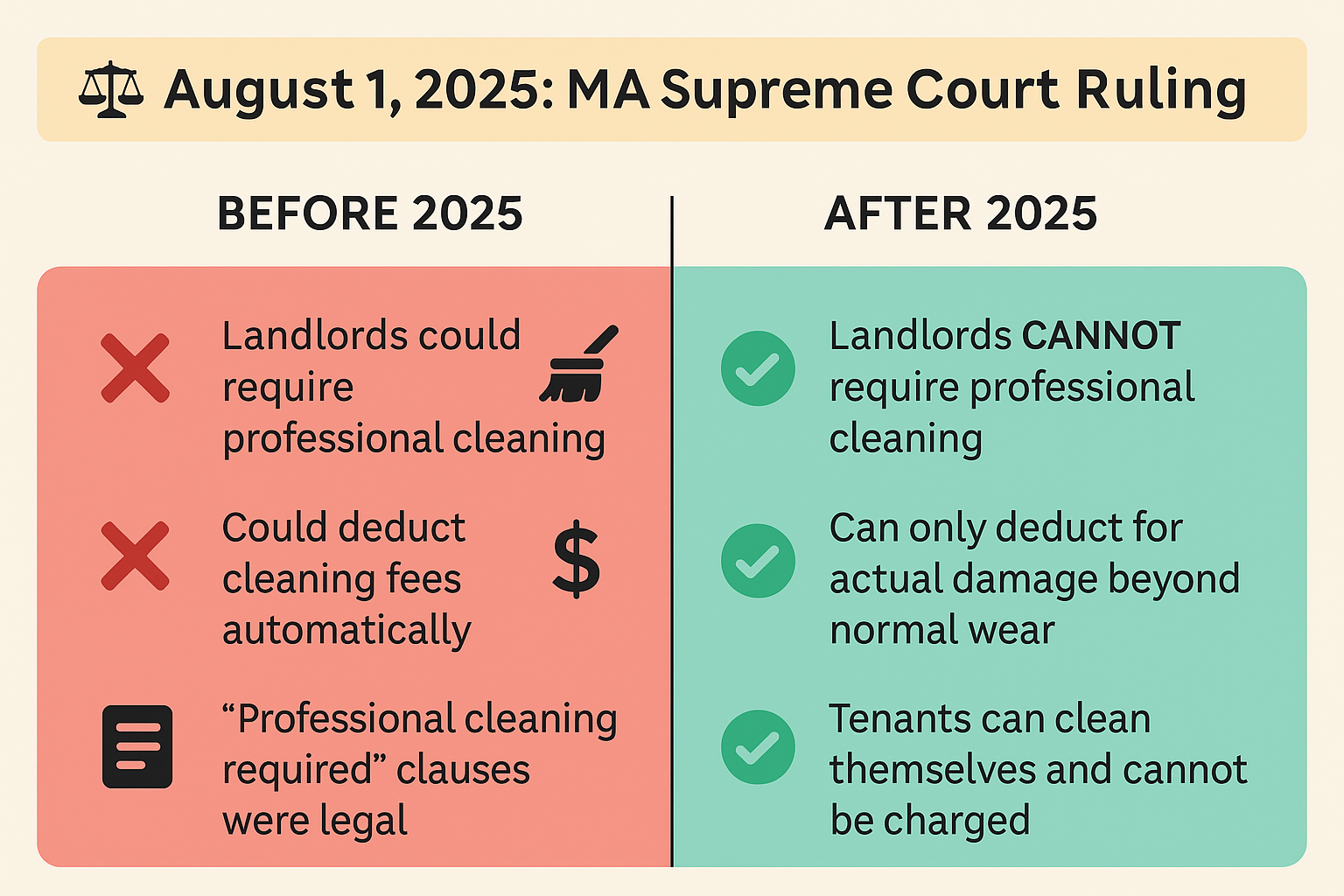
On August 1, 2025, the Massachusetts Supreme Judicial Court issued a landmark decision in Branda Peebles v. JRK Property Holdings that fundamentally changed the rules around security deposits and cleaning.
Here’s what the court ruled:
Landlords cannot deduct from your security deposit for:
- Routine painting
- Carpet shampooing or repair due to normal wear and tear
- Professional cleaning services (unless damage beyond normal use)
- General “wear and tear” refurbishment
What this means for you: Your landlord can require you to leave the unit clean, but they cannot automatically deduct “professional cleaning fees” from your deposit or require you to hire a professional cleaning service.
This is huge. Before this ruling, many Boston landlords included lease clauses requiring professional cleaning at move-out, with fees of $200-500 automatically deducted from deposits. That’s no longer legal.
Your Rights Under Massachusetts Law
Let’s break down exactly what the law says about security deposits and cleaning:
Security Deposit Basics
Maximum Amount: Your landlord cannot charge more than one month’s rent as a security deposit for an unfurnished apartment. (For a $2,500/month apartment, the maximum security deposit is $2,500.)
Where It Goes: Landlords must place your security deposit in a separate, interest-bearing bank account at a Massachusetts bank. You’re entitled to receive 5% interest or the actual interest earned (whichever is lower) if you stay longer than one year.
Documentation Required: Within 10 days of receiving your deposit, your landlord must provide a written “Statement of Condition” describing any existing damage to the apartment. (You should have received this when you moved in—if you didn’t, that’s a violation.)
Return Timeline: Within 30 days after you move out, your landlord must either:
- Return your full security deposit with interest, OR
- Return the remaining balance with a detailed, itemized list of deductions supported by receipts and invoices
What Landlords CAN Deduct From Your Deposit
After you move out, Massachusetts law allows landlords to use your security deposit only for:
- Unpaid rent (unless you lawfully withheld it due to habitability issues)
- Unpaid water bills (if you were responsible for water under your lease)
- Cost of repairs for actual damage you, your guests, or your pets caused
That’s it. Nothing else.
What Landlords CANNOT Deduct
Here’s where it gets important for cleaning:
❌ Routine painting (unless you painted the walls purple without permission)
❌ Normal wear and tear on carpets
❌ Routine cleaning to restore the unit to its original condition
❌ Professional cleaning fees (as of the 2025 ruling)
❌ Carpet shampooing for normal wear
❌ Replacing items at the end of their normal lifespan
❌ Small nail holes from hanging pictures
The Key Phrase: “Normal wear and tear”
Massachusetts law protects you from charges for “reasonable wear and tear.” But what does that mean?
Normal wear and tear includes:
- Furniture indentations in carpet
- Minor scuffs on walls
- Fading paint or wallpaper
- Worn carpet in high-traffic areas
- Minor scratches on hardwood floors from normal use
- Small nail holes (like from hanging pictures)
- Worn kitchen countertops from normal cooking
- Slight discoloration
NOT normal wear and tear (you can be charged):
- Large holes in walls
- Pet damage to floors or doors
- Burns on countertops or carpet
- Broken fixtures or appliances
- Stains (wine, grease, permanent marks)
- Broken windows
- Mold caused by your actions (not ventilating)
Real Boston Examples: What Passes and What Fails
Let’s look at actual scenarios from Boston apartments we’ve cleaned:
✅ PASS: Cambridge Triple-Decker, 3-Year Tenancy
- Slightly worn hardwood floors from foot traffic
- Minor scuff marks on walls near doorways
- Small nail holes from hanging pictures
- Faded paint in sunny living room
- Result: Full deposit returned (normal wear and tear)
✅ PASS: Beacon Hill Studio, 2-Year Tenancy
- Light discoloration on carpet in main living area
- Minor scratches on countertop from normal use
- Slightly worn cabinet finish in kitchen
- Result: Full deposit returned (normal wear and tear)
❌ FAIL: South End 1BR, 1-Year Tenancy
- Red wine stain on living room carpet
- Grease buildup on stove and backsplash (months of accumulation)
- Mold in bathroom from never using exhaust fan
- Result: $450 deduction for professional carpet cleaning and deep kitchen cleaning
❌ FAIL: Allston 2BR, Student Rental
- Multiple large holes in walls from shelving
- Broken closet door
- Permanent marker on walls in bedroom
- Kitchen left extremely dirty with food residue
- Result: $800+ in deductions
The Lesson: You’re responsible for actual damage and extreme uncleanliness, but not for normal living wear.
What About the “Broom-Clean” Requirement?
Most Boston leases include language requiring you to return the apartment “broom-clean” or “in the same condition as when you moved in, normal wear and tear excepted.”
So what does “broom-clean” legally mean in Massachusetts?
Technically: The term isn’t defined in Massachusetts statute. Courts have interpreted it to mean:
- Swept floors
- Removed trash and debris
- Empty apartment (all your belongings removed)
- Basic surface cleaning
Practically: Most Boston landlords expect significantly more than this minimum standard. While they can’t charge you for professional cleaning automatically, they can deduct if you leave the apartment genuinely dirty—not from normal use, but from neglect.
Think of it this way:
- Legal minimum: Broom-clean (swept, empty, trash out)
- Practical reality: Move-out clean (deep cleaned kitchen/bathrooms, vacuumed, mopped, wiped surfaces)
- Not required: Professional-grade clean (unless you caused significant mess)
We’ll cover exactly what “move-out clean” looks like in Section 3 with our detailed checklist.
How to Protect Yourself: Documentation Is Everything
Here’s the single most important thing you can do to protect your security deposit:
DOCUMENT EVERYTHING
At Move-In:
- Take photos of every room from multiple angles
- Photograph any existing damage, stains, wear
- Date-stamp all photos
- Review the Statement of Condition carefully
- Note any damage not listed and inform your landlord in writing
- Keep all documentation in a safe place
At Move-Out:
- Take photos of every room after cleaning
- Photograph areas that were damaged at move-in (to show no change)
- Date-stamp all photos
- If you hired professional cleaners, keep the receipt
- Take video walkthrough if possible
- Attend the final walkthrough with your landlord if offered
- Get the walkthrough report in writing and signed
Pro Tip from 500+ Boston Move-Outs: We’ve seen countless disputes resolved simply because the tenant had photos. The landlord claimed damage; the tenant showed photos proving it was pre-existing. Case closed, deposit returned.
What If Your Landlord Doesn’t Return Your Deposit?
If your landlord doesn’t return your security deposit within 30 days, or withholds money unfairly, you have options:
Step 1: Send a Written Demand Send a certified letter requesting the return of your deposit and citing Massachusetts General Law Chapter 186, Section 15B. (Free templates available at MassLegalHelp.org)
Step 2: Small Claims Court If the landlord still doesn’t comply, you can sue in Small Claims Court for:
- Triple damages (3x the amount wrongfully withheld)
- 5% interest from the date the deposit should have been returned
- Court costs
- Reasonable attorney fees
Example: If your landlord wrongfully keeps $500 of your deposit, you could potentially recover $1,500 plus interest, court costs, and attorney fees.
This threat alone often results in landlords returning deposits quickly.
Free Legal Resources:
- Massachusetts Legal Help: masslegalhelp.org
- Greater Boston Legal Services: gbls.org
- Housing Court Self-Help: mass.gov/housing-court
Key Takeaways: Know Your Rights
✅ As of 2025, landlords cannot require professional cleaning or automatically deduct cleaning fees
✅ You must leave the apartment clean, but not professionally cleaned
✅ Normal wear and tear cannot be charged to your deposit
✅ Document everything with photos at move-in and move-out
✅ Landlords have 30 days to return deposit or provide itemized deductions with receipts
✅ You can sue for triple damages if landlord violates deposit laws
✅ When in doubt, communicate in writing and keep records
Understanding your rights is the first step to protecting your security deposit. Now let’s talk about what “clean” actually means in practical terms.
Section 2: The “Broom-Clean” Standard Explained
Now that you understand your legal rights, let’s get practical. What does it actually mean to leave your Boston apartment “clean enough” to get your security deposit back?
The answer depends on three factors:
- Your lease requirements
- Your landlord’s expectations
- The condition you found it in (documented in your Statement of Condition)
The Three-Level Cleaning Framework
Based on our experience with hundreds of Boston move-outs, we’ve identified three cleaning levels. Understanding these will help you decide how much effort (or professional help) you need.
Level 1: Broom-Clean (Legal Minimum)
What it includes:
- Floors swept or vacuumed
- Trash and debris removed completely
- All your belongings out
- No food left in refrigerator/pantry
- Basic surface wiping
- Apartment empty and accessible
Time required: 2-4 hours for average apartment
Cost: Minimal (basic supplies: $20-40)
When it’s enough:
- Your lease specifically says “broom-clean” only
- The apartment was already somewhat dirty when you moved in (documented)
- Student rental with low landlord expectations
- You’re willing to risk some deductions
Reality check: While this is the legal minimum, most Boston landlords expect more. This level might get you 80-90% of your deposit back, but you’ll likely see some cleaning deductions.
Level 2: Move-Out Ready (Recommended Standard)
What it includes: Everything in Level 1, plus:
- Kitchen deep cleaned (appliances inside and out)
- Bathrooms thoroughly scrubbed
- All floors vacuumed AND mopped
- All surfaces wiped down
- Windows cleaned (interior)
- Baseboards wiped
- Light fixtures dusted
- Cabinets and drawers cleaned inside
Time required: 6-12 hours for average 2BR apartment
Cost if DIY: $75-150 in supplies and equipment
Cost if professional: $350-550 for 2BR in Boston
When it’s enough:
- Most Boston apartments
- Professional landlords/property management companies
- You want high confidence in getting full deposit back
- The apartment was clean when you moved in
Reality check: This is what most responsible Boston tenants do, and it typically results in full or nearly-full deposit returns. This is our recommended standard.
Level 3: Like-New Condition (Premium)
What it includes: Everything in Level 2, plus:
- Deep grout scrubbing
- Baseboard painting touch-ups (if allowed)
- Window washing exterior
- Blind cleaning
- Wall washing
- Cabinet deep cleaning and polishing
- Professional carpet cleaning (if applicable)
- Detailed work in every corner
Time required: 12-20 hours for average apartment
Cost if DIY: $150-250 in supplies and equipment rental
Cost if professional: $450-700+ for 2BR in Boston
When it’s necessary:
- Luxury buildings (Seaport, Back Bay high-rises)
- Very strict landlords
- Apartment was spotless when you moved in
- High-value security deposit ($3,000+)
- You caused more than normal wear
Reality check: This goes beyond legal requirements but guarantees no disputes. Usually only needed for luxury buildings or if you’ve caused some damage.
How Boston Neighborhoods Differ in Expectations
Here’s something most move-out guides won’t tell you: cleaning expectations vary significantly by Boston neighborhood.
We’ve cleaned move-outs across the entire Boston area, and landlord standards are NOT the same everywhere.
Back Bay & South End
Building type: Victorian brownstones, luxury condos, renovated historic buildings
Landlord profile: Professional property managers, high-end owners
Typical expectation: Level 2-3
Why: These are premium neighborhoods with premium rents. Landlords maintain high standards and have no trouble finding new tenants, so they’re particular about condition.
Special attention needed:
- Hardwood floors (common and scrutinized)
- Original fixtures in older buildings
- Exposed brick walls (dust accumulation)
- High-end appliances in renovated units
Average security deposit: $2,500-4,000
Our recommendation: Strongly consider professional cleaning
Allston & Brighton
Building type: Older multi-family homes, triple-deckers, student housing
Landlord profile: Mix of individual owners and student-focused property managers
Typical expectation: Level 1-2
Why: High student turnover means landlords are accustomed to more wear and tear. They price this into their model. However, don’t confuse “used to students” with “doesn’t care”—landlords still expect basic cleanliness.
Special attention needed:
- Kitchen (major issue in student housing)
- Carpet stains (common with parties)
- Bathroom basics
- Remove all your stuff completely
Average security deposit: $1,800-2,800
Our recommendation: Solid Level 2 cleaning, especially kitchen
September 1st Special Note: If you’re moving out on Boston’s infamous September 1st moving day (when most student leases turn over), landlords know it’s chaotic. Many are more lenient on timing but not on cleanliness. Clean on August 30th if possible.
Cambridge
Building type: Mix of student housing near universities, professional housing, single-family homes
Landlord profile: Highly varied—from individual homeowners to large property companies
Typical expectation: Level 2-3
Why: Cambridge has a mix of students, professionals, and families. Landlords tend to be more educated about tenant law and maintain higher standards.
Special attention needed:
- Varies by property type
- Near MIT/Harvard: Similar to Allston (student expectations)
- Porter Square/North Cambridge: Higher professional standards
- Older buildings: Pay attention to quirks (old fixtures, hardwood care)
Average security deposit: $2,200-3,500
Our recommendation: Assess your specific landlord and building type
Seaport & Fenway (New Luxury High-Rises)
Building type: Modern luxury apartments, high-amenity buildings
Landlord profile: Large professional property management companies
Typical expectation: Level 3
Why: These buildings command premium rents ($3,000+ for 1BR) and attract tenants who expect perfection. Management companies have detailed move-out inspection checklists.
Special attention needed:
- Stainless steel appliances (show every fingerprint)
- Glass surfaces (shower doors, windows)
- Modern fixtures (easy to notice anything off)
- Open floor plans (everything visible)
- White/light interiors (stains stand out)
Average security deposit: $3,500-5,000+
Our recommendation: Professional cleaning almost always worth it
Dorchester, Roxbury, Mattapan
Building type: Mix of single-family, multi-family, varying quality
Landlord profile: Highly varied—from individual owners to small property companies
Typical expectation: Level 1-2 Why: More affordable neighborhoods with more flexible standards, though this varies significantly by specific landlord.
Special attention needed:
- Read your specific lease carefully
- Check Statement of Condition for move-in standards
- Communicate with your landlord about expectations
Average security deposit: $1,500-2,500
Our recommendation: Match the condition you found it in
South Boston
Building type: Mix of older triple-deckers and newer luxury buildings
Landlord profile: Varies widely
Typical expectation: Level 2
Why: Southie has gentrified significantly, creating a mix of older affordable units and new luxury buildings. Expectations depend entirely on which type you’re in.
Special attention needed:
- Coastal location = salt damage in winter
- Check for moisture issues
- Older buildings: lower expectations
- Newer buildings: higher expectations
Average security deposit: $2,000-3,500
Our recommendation: Assess your specific building
The Statement of Condition: Your Most Important Document
Remember that Statement of Condition your landlord was supposed to give you within 10 days of move-in? That document is your baseline.
Here’s why it matters:
You’re only responsible for leaving the apartment in the same condition as you found it (minus normal wear and tear).
If your Statement of Condition noted:
- “Scratches on hardwood in living room” → You don’t need to fix existing scratches
- “Grout stained in bathroom” → Not your responsibility to re-grout
- “Kitchen cabinets show wear” → You don’t need to refurbish cabinets
Golden Rule: Don’t clean better than the condition you moved into (unless you want to, or caused specific damage).
Example from a Cambridge Apartment: A tenant we worked with received a Statement of Condition that noted: “Oven shows grease buildup, kitchen floor has stains, bathroom grout is discolored.”
When they moved out, the landlord tried to deduct $300 for oven cleaning and floor refinishing. The tenant showed their Statement of Condition, proving these issues existed before they moved in. Landlord returned full deposit.
How to Use This Framework
Step 1: Find your Statement of Condition from move-in
Step 2: Identify your neighborhood and building type (see above)
Step 3: Determine appropriate cleaning level:
- Luxury building or strict landlord → Level 3
- Standard Boston apartment → Level 2
- Student housing or as-is condition → Level 1-2
Step 4: Calculate if professional cleaning is worth it (we’ll cover costs in Section 5)
Step 5: Use our room-by-room checklist (coming in Section 3)
Key Takeaways: Understanding “Clean Enough”
✅ “Broom-clean” is the legal minimum, but most Boston landlords expect Level 2 (move-out ready)
✅ Neighborhood matters: Back Bay ≠ Allston in landlord expectations
✅ Match the condition you moved into using your Statement of Condition as proof
✅ Security deposit size matters: $1,500 deposit = maybe DIY; $4,000 deposit = consider professional
✅ When in doubt, go one level higher than you think necessary
Now that you understand what “clean” means, let’s get into the specifics. In the next section, we’ll give you the exact room-by-room checklist used by professional cleaners across Boston.
Section 3: The Complete Boston Move-Out Cleaning Checklist
Now we get to the heart of it: exactly what to clean, how to clean it, and how long it takes. This is the same checklist our professional team uses when cleaning Boston apartments, refined over 500+ move-outs.
Before You Start:
- [ ] Review your Statement of Condition from move-in
- [ ] Take “before cleaning” photos of each room
- [ ] Gather all necessary supplies (see list below)
- [ ] Set aside enough time (don’t rush!)
- [ ] Open windows for ventilation
Estimated Total Time:
- Studio: 4-6 hours
- 1BR: 6-8 hours
- 2BR: 8-12 hours
- 3BR: 12-16 hours
These times assume moderate cleaning needs. Add 50% more time if your apartment needs serious work.
KITCHEN: The #1 Deposit-Killer (Budget 30-60 minutes)
The kitchen is where most Boston tenants lose deposit money. Landlords ALWAYS inspect the oven, and grease buildup is the most common deduction we see.
Pro tip from 500+ cleanings: Start with the oven first thing in the morning. Spray it with cleaner and let it sit while you clean other rooms. The soaking time makes a huge difference.
Oven & Stove (15-20 minutes)
This is non-negotiable. Even if you skip other areas, DO NOT skip the oven.
Step-by-step:
- [ ] Remove oven racks and soak in hot soapy water
- [ ] Spray oven interior with oven cleaner OR make paste with baking soda and water
- [ ] Let sit 30+ minutes (seriously, don’t skip this)
- [ ] Scrub interior with non-scratch sponge
- [ ] Wipe clean with damp cloth multiple times
- [ ] Clean oven door inside and out (don’t forget between glass layers if accessible)
- [ ] Scrub oven racks and replace
- [ ] Clean stovetop burners (remove if gas stove)
- [ ] Degrease stovetop surface
- [ ] Clean knobs (pull off and wash separately)
- [ ] Wipe down range hood and filter
Boston-specific note: Many Allston/Brighton apartments have ancient gas stoves. The drip pans rust easily—if they’re beyond saving, consider replacing them ($10-20 at hardware store) rather than risk a deduction.
Common failures we see:
❌ Only cleaning oven exterior (landlord will check inside!)
❌ Not soaking oven cleaner long enough
❌ Forgetting the space between glass doors
❌ Missing grease on range hood
For detailed oven cleaning techniques, see our guide on how to maintain kitchen cleanliness.
Refrigerator & Freezer (15-20 minutes)
The second most commonly cited issue in Boston move-outs.
Step-by-step:
- [ ] Remove all food (check door shelves!)
- [ ] Remove all shelves and drawers
- [ ] Wash shelves and drawers with warm soapy water
- [ ] Wipe interior walls with baking soda solution (removes odors)
- [ ] Don’t forget the rubber door seal (crumbs hide here!)
- [ ] Clean freezer completely (let ice melt if needed)
- [ ] Wipe exterior including handles
- [ ] Clean TOP of fridge (dust accumulates, landlords check!)
- [ ] Pull fridge out and sweep/mop behind it
- [ ] Clean drip pan underneath (if accessible)
- [ ] Leave door slightly open when done (prevents mildew)
Boston-specific note: Many Cambridge and Somerville apartments have very old refrigerators. Clean the coils on the back if accessible—landlords appreciate this even though not required.
What we find in Boston fridges:
- Forgotten condiments from 2019
- Mystery items in back of freezer
- Forgotten produce in crisper drawers
- Dust bunnies on top (seriously, everyone forgets the top)
Dishwasher (5-10 minutes)
Quick but important.
- [ ] Remove any dishes, check all racks
- [ ] Remove and clean filter at bottom (this gets gross!)
- [ ] Run empty cycle with white vinegar (1 cup in bottom)
- [ ] Wipe door seal and edges
- [ ] Clean exterior and handle
- [ ] Leave door slightly open when done
Microwave (5 minutes)
- [ ] Heat bowl of water with lemon for 3 minutes (steam loosens grime)
- [ ] Wipe interior thoroughly
- [ ] Remove and wash turntable
- [ ] Clean exterior and door
- [ ] Don’t forget the vents on top/sides
Cabinets & Drawers (10-15 minutes)
Step-by-step:
- [ ] Empty ALL cabinets completely (check way in back!)
- [ ] Vacuum crumbs from shelves
- [ ] Wipe all interior surfaces
- [ ] Clean exterior cabinet doors (remove grease/fingerprints)
- [ ] Wipe cabinet hardware (knobs, handles)
- [ ] Don’t forget under-sink cabinet (check for leaks too!)
- [ ] Clean inside drawers
- [ ] Wipe drawer fronts
Boston landlord pet peeve: Sticky shelf liner residue. If you added liners, remove them completely and clean residue with Goo Gone.
Sink & Countertops (10 minutes)
- [ ] Remove hard water stains from sink (use Bar Keeper’s Friend)
- [ ] Clean and shine faucet
- [ ] Scrub countertops thoroughly
- [ ] Clean backsplash (grease splatters hide here)
- [ ] Wipe down any windowsills above sink
- [ ] Clean garbage disposal (if present) – run ice cubes through
- [ ] Polish stainless steel (if applicable)
Boston water is hard: You’ll need stronger cleaner for calcium buildup on faucets. White vinegar or CLR works well.
Floors (5-10 minutes)
- [ ] Sweep thoroughly (especially corners and under table area)
- [ ] Mop with appropriate cleaner for your floor type
- [ ] Get edges and baseboards
- [ ] Move any appliances and clean underneath if possible
Boston-specific: Many older apartments have old linoleum. Don’t use harsh chemicals that could damage it. Mild dish soap and water works fine.
Kitchen Final Checklist:
- [ ] Wipe light fixtures and ceiling fan
- [ ] Clean light switches and outlet covers
- [ ] Wipe door and door frame
- [ ] Take out any trash
- [ ] One final look for anything missed
Kitchen supplies you’ll need:
- Oven cleaner or baking soda
- All-purpose cleaner
- Degreaser
- Bar Keeper’s Friend (for sinks)
- Sponges (non-scratch)
- Microfiber cloths
- Rubber gloves
- Vacuum
- Mop and bucket
BATHROOMS: Where Neglect Shows (Budget 20-30 minutes per bathroom)
Bathrooms in Boston apartments see a lot of wear, especially in older buildings with hard water. The key is addressing mineral buildup, mildew, and soap scum.
For comprehensive bathroom cleaning techniques, check our ultimate bathroom cleaning guide.
Toilet (10 minutes)
No one likes this job, but landlords ALWAYS check.
Step-by-step:
- [ ] Pour toilet bowl cleaner inside bowl and let sit
- [ ] Use toilet brush to scrub bowl thoroughly
- [ ] Use pumice stone for stubborn hard water rings (common in Boston!)
- [ ] Don’t forget under the rim
- [ ] Wipe exterior of toilet with disinfectant
- [ ] Clean behind toilet (yes, back there)
- [ ] Wipe down toilet base where it meets floor
- [ ] Clean toilet handle/button
- [ ] Replace toilet brush if it’s yours (never leave old brush)
Boston plumbing issue: Old pipes = hard water = ring around toilet. A pumice stone is your best friend. You can find one at any hardware store for $5.
Shower & Tub (15-20 minutes)
This is where Boston renters often lose money. Soap scum and mildew are hard to remove if you’ve let them build up.
Step-by-step:
- [ ] Remove all personal items (shampoo, soap, etc.)
- [ ] Spray entire shower/tub with bathroom cleaner
- [ ] Let sit 10-15 minutes
- [ ] Scrub tile and grout with stiff brush
- [ ] Pay special attention to corners and edges (mildew loves these spots)
- [ ] Clean glass shower doors with glass cleaner or vinegar
- [ ] Remove soap scum from doors (Magic Eraser works great)
- [ ] Scrub bathtub thoroughly
- [ ] Clean tub faucet and fixtures (remove hard water buildup)
- [ ] Clean showerhead (soak in vinegar if very clogged)
- [ ] Rinse everything thoroughly
- [ ] Wipe down shower curtain or rod if applicable
- [ ] Clean drain and remove hair (gross but necessary!)
Boston bathroom reality: Many older apartments have tile and grout that’s never been perfectly white. If your Statement of Condition shows pre-existing discoloration, you’re not responsible for restoring it to new. But you ARE responsible for removing your mildew and soap scum.
Products that work: For stubborn soap scum on glass, nothing beats a Magic Eraser. For grout, a mixture of baking soda and hydrogen peroxide left to sit for 30 minutes works wonders.
Sink & Vanity (10 minutes)
- [ ] Clean sink basin thoroughly
- [ ] Remove hard water stains (Bar Keeper’s Friend again)
- [ ] Clean and polish faucet and fixtures
- [ ] Wipe down countertop/vanity
- [ ] Clean inside medicine cabinet
- [ ] Wipe mirror (streak-free!)
- [ ] Clean cabinet/drawer fronts
- [ ] Empty and wipe inside drawers
- [ ] Don’t forget the space between sink and wall
Mirror trick: Use newspaper instead of paper towels for a streak-free finish. Or use a microfiber cloth with just water.
Bathroom Floors (10 minutes)
- [ ] Sweep or vacuum all corners
- [ ] Pay special attention to corners and around toilet base
- [ ] Mop with bathroom cleaner
- [ ] Get behind the toilet
- [ ] Clean baseboards
- [ ] Wipe down any heating vents
Boston apartments often have: Small bathroom tiles with lots of grout lines. Use a grout brush or old toothbrush for detailed cleaning.
Bathroom Final Checklist:
- [ ] Clean light fixtures
- [ ] Wipe light switches and outlet covers
- [ ] Clean bathroom door and frame
- [ ] Wipe down towel bars/toilet paper holder
- [ ] Check for mildew on ceiling (common in poorly-ventilated Boston bathrooms)
- [ ] Remove any hair from visible areas
- [ ] Take final photos
Bathroom supplies needed:
- Bathroom cleaner
- Toilet bowl cleaner
- Pumice stone
- Magic Erasers
- Scrub brush for grout
- Glass cleaner
- Disinfectant
- Rubber gloves
- Old toothbrush for details
BEDROOMS: Simpler But Still Important (Budget 15-20 minutes per bedroom)
Bedrooms are generally easier, but don’t skip them. Landlords check closets carefully.
Surfaces & Furniture (5 minutes)
- [ ] Dust all surfaces (windowsills, any built-in shelves)
- [ ] Wipe down any remaining furniture you’re leaving
- [ ] Clean light fixtures and replace any burnt bulbs
- [ ] Wipe ceiling fan blades if present
- [ ] Clean closet shelving and hanging rods
- [ ] Wipe inside and outside of closet doors
Floors (10 minutes)
- [ ] Vacuum carpets thoroughly (go over high-traffic areas multiple times)
- [ ] Get corners and edges
- [ ] Vacuum under radiators (Boston apartment staple!)
- [ ] For hardwood: sweep then mop with wood-safe cleaner
- [ ] Address any visible carpet stains if possible
- [ ] Move any furniture and clean underneath
Boston radiator note: Dust accumulates heavily behind and under radiators during heating season. Landlords often check this. Use vacuum hose attachment or a radiator brush.
For carpet stain removal tips, see our guide on how to clean carpet like a pro.
Windows (5-10 minutes per bedroom)
- [ ] Clean window glass inside (Windex or vinegar solution)
- [ ] Clean window tracks and sills (vacuum first, then wipe)
- [ ] Remove any stickers or residue from glass
- [ ] Clean window screens if removable
Boston windows collect: Salt residue in winter, pollen in spring. Pay extra attention to tracks—they get genuinely grimy.
Check our detailed window cleaning guide for streak-free results.
Bedroom Final Checklist:
- [ ] Wipe light switches and outlets
- [ ] Clean door and door frame
- [ ] Check walls for any damage (nail holes, marks)
- [ ] Wipe baseboards
- [ ] Ensure closet is completely empty
- [ ] Take photos of clean room
LIVING AREAS: Where Everything Shows (Budget 20-30 minutes)
Living rooms, dining areas, and hallways need attention because they’re highly visible.
General Living Area Cleaning:
- [ ] Dust all surfaces (shelves, entertainment center, etc.)
- [ ] Clean any remaining furniture
- [ ] Dust/wipe light fixtures
- [ ] Clean ceiling fans (if present)
- [ ] Wipe all switch plates and outlets
- [ ] Clean windows and window tracks
- [ ] Vacuum or mop floors thoroughly
- [ ] Wipe baseboards throughout
- [ ] Clean any built-in features (fireplace facing, built-in shelves)
Boston-specific items to check:
- [ ] Radiators (clean dust from fins)
- [ ] Exposed brick (dust accumulates) – common in South End/Back Bay
- [ ] Original hardwood (sweep thoroughly before mopping)
- [ ] Window wells (basement apartments)
THE MOST COMMONLY FORGOTTEN AREAS ⚠️
These are the items that cost Boston tenants the most deposit money:
1. Inside the Oven (Already covered, but worth repeating)
Why it’s forgotten: Out of sight, out of mind
Landlord perspective: First thing they check
Cost of missing it: $75-150
2. Behind and Under the Refrigerator
Why it’s forgotten: Requires moving heavy appliance
What’s usually there: Dust, food debris, sometimes mold
How to handle: Pull fridge out, sweep, mop underneath and behind
Cost of missing it: $50-100
3. Top of Kitchen Cabinets
Why it’s forgotten: Above eye level
What’s usually there: Thick layer of greasy dust
How to handle: Use step ladder, wipe with degreaser
Cost of missing it: $25-50
4. Window Tracks
Why it’s forgotten: People clean glass but not tracks
What’s usually there: Dirt, dead bugs, salt residue (Boston winters!)
How to handle: Vacuum first, then scrub with old toothbrush
Cost of missing it: $30-50 per window
Boston-specific: Winter salt gets tracked in and accumulates in window tracks. If you’re doing a winter move-out, pay extra attention here.
5. Light Fixtures
Why it’s forgotten: Above eye level, seems minor
What’s usually there: Dead bugs, dust
How to handle: Remove glass covers if possible, wash and dry
Cost of missing it: $20-40
6. Baseboards
Why it’s forgotten: Below eye level, tedious to clean
What’s usually there: Dust, scuff marks, salt stains (Boston!)
How to handle: Wipe down entire perimeter of each room with damp cloth
Cost of missing it: $50-100
7. Inside Cabinets and Drawers
Why it’s forgotten: Assumption that empty = clean
What’s usually there: Crumbs, spills, shelf liner residue
How to handle: Wipe all interior surfaces
Cost of missing it: $40-80
8. Closet Shelves and Rods
Why it’s forgotten: People focus on main living spaces
What’s usually there: Dust, sometimes old hangers
How to handle: Wipe all shelves and rods, remove everything
Cost of missing it: $30-60
9. Behind the Toilet
Why it’s forgotten: Awkward to reach
What’s usually there: Dust, sometimes mildew
How to handle: Use cleaner on cloth, reach back and wipe
Cost of missing it: $20-40
10. Range Hood Filter
Why it’s forgotten: Hidden, people clean hood exterior only
What’s usually there: Accumulated grease
How to handle: Remove filter, soak in hot soapy water or dishwasher
Cost of missing it: $30-60
THE FINAL WALKTHROUGH CHECKLIST
Do this walkthrough in daylight (better visibility) before your landlord inspection:
Kitchen:
- [ ] Open oven – is it clean?
- [ ] Open fridge – is it clean and empty?
- [ ] Look inside all cabinets – empty and wiped?
- [ ] Check top of cabinets – dust-free?
- [ ] Look behind/under fridge – clean?
Bathrooms:
- [ ] Check grout – scrubbed?
- [ ] Look behind toilet – clean?
- [ ] Check shower doors – no soap scum?
- [ ] Open medicine cabinet – empty?
- [ ] Check drain – hair removed?
All Rooms:
- [ ] Check closets – completely empty?
- [ ] Look at baseboards – wiped down?
- [ ] Check window tracks – clean?
- [ ] Look up at light fixtures – dusted?
- [ ] Check radiators (if present) – dusted?
Entire Apartment:
- [ ] All trash removed?
- [ ] All belongings gone?
- [ ] All keys accounted for?
- [ ] Smell okay? (air out if needed)
- [ ] Lights all working?
- [ ] Nothing left behind anywhere?
Section 4: Seasonal Considerations for Boston Move-Outs
Boston’s weather creates unique cleaning challenges depending on when you’re moving out. Here’s what you need to know for each season.
Winter Move-Outs (December – February)
Winter moves in Boston present specific challenges that don’t exist in other seasons.
Unique Challenges:
1. Salt and Ice Melt Damage
- Tracked in from shoes on every trip
- Leaves white residue on floors, baseboards, carpets
- Can damage hardwood if not cleaned properly
What to do:
- Place large mats at entry during your final move-out trips
- Clean floors last (after all moving is done)
- Use vinegar solution (1:1 with water) for hardwood salt stains
- Vacuum carpets multiple times to get embedded salt
- Pay extra attention to entryway and hallway baseboards
2. Window Condensation Buildup
- Boston’s old apartments + cold weather = condensation
- Can lead to mildew on windowsills
- Water damage if not addressed
What to do:
- Check all windowsills for water damage or mildew
- Clean and dry thoroughly
- Wipe window tracks (condensation pools here)
- If you see mold, clean with bleach solution
3. Radiator Dust Accumulation
- Heating season means radiators run constantly
- Dust accumulates heavily on fins and behind units
- Very noticeable to landlords
What to do:
- Vacuum radiator fins with brush attachment
- Use radiator brush for between fins
- Clean floor area behind and under radiators
- Wipe top of radiator unit
4. Shorter Daylight Hours
- Dark by 4:30 PM in December/January
- Harder to see dirt and spots you’ve missed
- Artificial light doesn’t reveal everything
What to do:
- Start cleaning early in the day (maximize natural light)
- Use bright lights while cleaning
- Do final inspection during peak daylight hours
- Consider cleaning over 2 days to use daylight twice
5. Moving Day Complications
- Snow/ice can delay moving trucks
- Cold temperatures make cleaning harder
- Water freezes in buckets outside
What to do:
- Build in extra time for weather delays
- Heat apartment well while cleaning
- Have backup cleaning date if weather is severe
Winter Move-Out Timeline:
- Day 3 before: Clean interior thoroughly
- Day 2 before: Address any salt damage
- Day 1 before: Final walkthrough in daylight
- Move-out day: Quick sweep/wipe of salt tracked during moving
Spring Move-Outs (March – May)
Spring is the second-busiest moving season in Boston, especially in May with college graduations.
Unique Challenges:
1. Pollen on Windows and Sills
- Boston spring = heavy pollen
- Yellow dust on everything
- Especially bad if windows were open
What to do:
- Clean windows last (after moving done)
- Wipe sills with damp cloth
- Don’t forget exterior sills if accessible
- Check window screens for pollen buildup
2. May College Exodus
- Entire neighborhoods (Allston, Brighton) move at once
- Professional cleaners are FULLY BOOKED
- Landlords know it’s chaos
What to do:
- Book professional cleaning by early April if going that route
- If DIY, clean by May 25th (before the rush)
- Landlords may be more lenient on timing due to chaos
- Document everything extra carefully (lots of rushed move-outs)
3. Mud Season
- March-April = melting snow + rain = mud
- Tracked into apartments during moving
- Floor damage if not addressed
What to do:
- Put down cardboard paths during moving
- Clean floors after all moving is complete
- Have extra mop water ready
- Check baseboards for mud splatter
4. Spring Cleaning Expectations
- Landlords associate spring with “deep cleaning”
- May have higher expectations than other seasons
- Fresh start mentality
What to do:
- Go slightly above baseline cleaning expectations
- Open windows to air out apartment
- Pay attention to freshness and smell
Summer Move-Outs (June – August)
Fewer moves happen in summer, but heat creates its own challenges.
Unique Challenges:
1. Heat and Humidity
- Boston summers are hot and humid
- Cleaning is physically exhausting
- Sweat dripping while you work
What to do:
- Clean early morning (coolest part of day)
- Stay hydrated
- Take breaks in air conditioning
- Consider splitting cleaning over 2 days
- Use fans for air circulation
2. Late August Student Rush
- Second wave of student move-ins/outs
- August 31st/Sept 1st = chaos
- Professional cleaners book up
What to do:
- Book cleaning by mid-August if hiring professionals
- If you’re a student, clean August 28-29 (before the chaos)
- Expect landlords to be overwhelmed with turnovers
3. Vacation Schedules
- Your landlord might be on vacation
- Harder to schedule walkthroughs
- Delays in deposit return
What to do:
- Confirm walkthrough date early
- Get everything in writing
- Take extra photos if landlord can’t attend
- Follow up on deposit return timeline
4. Mold and Mildew Risk
- Summer humidity in Boston apartments
- Especially bathrooms and basements
- Can develop quickly if apartment sitting empty
What to do:
- Address any mildew immediately
- Leave bathroom fans on if possible
- Open windows for air circulation
- Check for mold in closets and under sinks
Fall Move-Outs (September – November)
September 1st is Boston’s busiest moving day of the entire year.

Unique Challenges:
1. September 1st = Boston Moving Day
- Estimates: 60-70% of Boston apartments turn over Sept 1st
- Streets are blocked with moving trucks
- Total chaos across the city
- Landlords processing dozens of turnovers
What to do:
- CRITICAL: Don’t wait until August 31st to clean!
- Clean by August 28-29
- Take extensive photos (landlord may not inspect until Sept 3-4)
- Mail keys certified/return receipt
- If hiring professionals, book by early August (they’re completely booked by mid-August)
- Consider doing walkthrough August 31st in early AM before trucks arrive
Reality check: Many landlords are reasonable about Sept 1st because they know it’s chaos. But don’t confuse “reasonable about timing” with “will accept dirty apartment.”
2. Leaf Debris
- Fall leaves track into apartments
- Especially in ground-floor units
- Balconies and patios collect leaves
What to do:
- Clean outdoor spaces
- Sweep entrance areas after moving
- Check for leaves in entryway corners
3. Back to School Rush
- Early September = student housing frenzy
- Competition for cleaners
- Landlords have immediate pressure to turn units
What to do:
- Be extra thorough (landlord wants quick turnover)
- Clean 3-4 days before move-out
- Offer to do walkthrough early if possible
4. Decreasing Daylight
- Days getting shorter
- By November, dark by 5 PM
- Need good lighting for cleaning
What to do:
- Clean during peak daylight hours
- Use bright artificial lights
- Final inspection before 4 PM
Seasonal Cleaning Supply Adjustments
Winter: Add vinegar for salt stains, extra floor cleaning supplies
Spring: Add window cleaner for pollen, allergy-friendly products
Summer: Add fans, cooling towels, extra water for you
Fall: Add extra vacuum bags for leaves, outdoor broom
Section 5: Cost Breakdown – DIY vs. Professional Cleaning in Boston
Now for the question everyone wants answered: Should you clean it yourself or hire professionals?
The answer depends on your specific situation, but let’s break down all the factors so you can make an informed decision.
DIY Move-Out Cleaning: True Cost Analysis
Many people think DIY is “free” because they’re doing the work themselves. But there are real costs—both monetary and otherwise.
Time Investment:
Studio/1BR: 4-6 hours
- Kitchen: 1-1.5 hours
- Bathroom: 1-1.5 hours
- Bedroom: 1 hour
- Living area: 1 hour
- Final details: 30-60 minutes
2BR Apartment: 8-12 hours
- Kitchen: 1.5-2 hours
- Bathrooms (2): 2-3 hours
- Bedrooms (2): 2 hours
- Living areas: 2 hours
- Final details: 1 hour
3BR Apartment: 12-16 hours
- Kitchen: 2-2.5 hours
- Bathrooms (2-3): 3-4 hours
- Bedrooms (3): 3 hours
- Living areas: 2-3 hours
- Final details: 1-2 hours
House: 16-24+ hours depending on size
Reality Check: These are estimates for someone who knows what they’re doing. First-timers often take 50-100% longer.
Supply Costs (Boston Area):
Basic Cleaning Kit: $50-75
- All-purpose cleaner: $5-8
- Glass cleaner: $4-6
- Bathroom cleaner: $5-8
- Floor cleaner: $6-10
- Paper towels/rags: $8-12
- Sponges and scrub brushes: $8-12
- Rubber gloves: $3-5
- Trash bags: $8-10
- Vacuum bags (if needed): $8-12
Specialty Products: $30-50
- Oven cleaner: $6-10
- Bar Keeper’s Friend (sinks): $4-6
- Magic Erasers: $5-8
- Pumice stone (toilets): $3-5
- Wood polish/cleaner: $6-10
- Grout brush: $4-6
- Window squeegee: $5-8
Equipment You May Need to Rent:
- Carpet cleaner: $30-60/day (Home Depot, nearby hardware stores)
- Floor buffer: $40-70/day
- Steam cleaner: $35-50/day
Total DIY Investment: $110-200+
(This assumes you already own a vacuum, mop, and basic bucket. If not, add $80-150 for equipment.)
Hidden Costs of DIY:
1. Your Time Value If you make $25/hour at work and spend 10 hours cleaning, that’s $250 in opportunity cost. Could you work overtime instead and hire a cleaner?
2. Physical Exhaustion Moving is already exhausting. Adding 10-16 hours of intensive cleaning on top of packing and moving can be overwhelming, especially if moving to a new city or starting a new job.
3. Risk of Missing Spots If you miss critical areas (like inside the oven or behind the fridge), you could lose $100-500 in deposit deductions—far more than professional cleaning would cost.
4. Multiple Trips If you don’t live close to your old apartment, you may need multiple trips back for cleaning, inspection, and key drop-off. Factor in time and gas/T fare.
5. No Guarantee If your landlord finds issues after you’ve moved out, you can’t easily go back and re-clean. Professional services often include a satisfaction guarantee.
Professional Move-Out Cleaning: Boston Pricing
Let’s break down what professional cleaning actually costs in Boston, and what you get for that money.
Average Boston Pricing (2025):
Studio/1BR:
- Standard: $250-350
- Deep clean: $300-400
- Luxury building: $350-500
2BR Apartment:
- Standard: $350-500
- Deep clean: $400-550
- Luxury building: $500-700
3BR Apartment:
- Standard: $450-650
- Deep clean: $550-750
- Luxury building: $650-900
4BR+ House:
- Standard: $600-900
- Deep clean: $750-1,200
- Luxury: $1,000-1,500+
Factors that affect price:
- Square footage
- Condition of apartment
- Neighborhood (parking/access difficulties)
- Additional services (see below)
- Urgency (rush fees for last-minute)
- Time of year (September = premium)
Common Add-Ons:
Inside Refrigerator Deep Clean: Usually included, but verify
Inside Oven Deep Clean: Usually included, but verify
Carpet Deep Cleaning: +$100-250 depending on size
Window Washing (Exterior): +$50-100
Balcony/Patio Cleaning: +$30-75
Blinds Cleaning: +$25-50
Interior of Cabinets: Usually included, but verify
Wall Washing: +$50-150
Get a free quote for your Boston apartment →
What’s Included in Professional Service:
✅ All cleaning supplies and equipment
✅ Professional-grade products
✅ Experienced cleaning team (usually 2-4 people)
✅ 2-4 hour completion time
✅ Quality guarantee
✅ Post-cleaning photos for your records
✅ Receipt for landlord (if requested)
✅ Insurance coverage
✅ Follow-up if landlord finds issues
What professional cleaners bring that you probably don’t have:
- Commercial-grade vacuum
- Professional mops and equipment
- Specialty products for tough stains
- Experience with Boston landlords’ expectations
- Knowledge of common inspection points
- Team efficiency (done in 1/4 the time)
- Proper tools for hard-to-reach areas
Neighborhood Pricing Variations in Boston:
Premium Neighborhoods (Higher Prices):
- Back Bay: +10-20% above average
- South End: +10-20% above average
- Seaport: +15-25% above average
- Beacon Hill: +10-15% above average
Why more expensive:
- Parking is difficult/expensive
- Buildings have strict access rules
- Higher cleaning standards expected
- Time spent on access/parking
Standard Pricing Neighborhoods:
- Cambridge
- Brookline
- Somerville
- Jamaica Plain
- South Boston
Budget-Friendly Neighborhoods:
- Allston/Brighton: Average or -5-10%
- Dorchester: -5-10% below average
- Roxbury: -5-10% below average
The Smart Decision Framework
Here’s how to decide what’s right for YOUR situation:
Choose DIY Cleaning If:
✅ Small space: Studio or 1BR under 600 sq ft
✅ Already relatively clean: You’ve maintained it well
✅ Time available: You have 1-2 full days
✅ Budget is very tight: Under $200 total available
✅ Low deposit: $800 or less at stake
✅ Physically able: Can handle intensive cleaning
✅ Have supplies/equipment: Won’t need to buy much
✅ Not urgent: Flexible move-out timeline
Best DIY scenarios:
- Student in small Allston apartment, deposit is $1,200, you have 2 days
- Young professional in clean studio, just need touch-ups
- Family with time, moving locally, can come back if needed
Choose Professional Cleaning If:
✅ Larger space: 2+ bedrooms
✅ High deposit: $2,000+ at stake
✅ Luxury building: Seaport, Back Bay high-rise
✅ Limited time: Moving this weekend
✅ Moving far away: Can’t easily return
✅ Strict landlord: Known to be picky
✅ Needs deep work: Hasn’t been cleaned well in months
✅ Physical limitations: Health issues, injury, etc.
✅ High stakes: Security deposit crucial for next apartment
✅ Peace of mind: Don’t want the stress
Best professional scenarios:
- 2BR in Cambridge, $2,800 deposit, moving to NYC
- Luxury condo in Seaport, $4,500 deposit
- 3BR with kids, no time between jobs
- Apartment needs serious work, landlord is strict
The ROI Calculation
Let’s do the math with real Boston examples:
Example 1: Cambridge 2BR
- Security Deposit: $2,800
- Professional Cleaning Cost: $450
- DIY Cost: ~$150 supplies + 10 hours of your time
Scenario A: Hire Professional
- Pay $450
- Get full $2,800 back
- Net: $2,350
- Time saved: 10 hours
Scenario B: DIY with 15% Deduction Risk
- Save $450 in cleaning fees
- Risk: Landlord deducts $420 (15% of deposit) for missed spots
- Net: $2,380 OR $1,960 (if deductions happen)
- Time spent: 10 hours
Smart choice: Professional cleaning provides certainty and saves time. The risk of deductions often exceeds the savings.
Example 2: Allston Studio (Student)
- Security Deposit: $1,200
- Professional Cleaning Cost: $280
- DIY Cost: ~$100 supplies + 5 hours
Scenario A: Hire Professional
- Pay $280
- Get full $1,200 back
- Net: $920
Scenario B: DIY with 10% Deduction Risk
- Save $280
- Risk: Landlord deducts $120 for oven/kitchen
- Net: $1,100 OR $980 (if deductions happen)
Smart choice: For students on tight budgets, DIY might make sense IF you have time and do it thoroughly. But the $180 difference isn’t huge.
Example 3: Seaport 2BR Luxury
- Security Deposit: $4,500
- Professional Cleaning Cost: $600
- DIY Cost: ~$200 supplies + 12 hours
Scenario A: Hire Professional
- Pay $600
- Get full $4,500 back
- Net: $3,900
Scenario B: DIY with 20% Deduction Risk
- Save $600
- Risk: Landlord deducts $900 (high standards not met)
- Net: $4,300 OR $3,400 (if deductions happen)
Smart choice: Professional cleaning is obvious. The risk is too high, and luxury buildings have exacting standards.
When to Book Professional Cleaning
Timeline matters in Boston:
Ideal Booking Timeline:
- Regular season: 2-3 weeks before move-out
- May (college graduation): Book by early April
- September 1st: Book by early-mid August
- Winter months: 1-2 weeks notice usually fine
What Happens If You Wait:
2 weeks before:
- Good availability
- Normal pricing
- Can choose time slots
1 week before:
- Limited availability
- May have rush fees
- Less flexible timing
3-4 days before:
- Very limited availability
- Likely rush fees (+20-50%)
- Take what you can get
Last minute (1-2 days):
- Often fully booked (especially peak season)
- High rush fees if available
- May not be possible at all
Brabos Cleaning Pro Tip: We try to accommodate last-minute bookings when possible, but we can’t guarantee availability. During September, we’re typically booked solid by mid-August.
contact us for your move-out date →
What to Do Before Professional Cleaners Arrive
To get the most value from professional cleaning:
Must Do:
- [ ] Remove ALL belongings completely
- Cleaners can’t work around your stuff
- This is the #1 reason appointments get delayed
- [ ] Take out all trash
- Don’t leave bags of trash for cleaners
- [ ] Empty refrigerator and cabinets
- Cleaners will clean inside, but you remove contents
- [ ] Arrange building access
- Keys, codes, parking passes
- Building doorman notification
- [ ] Move any remaining furniture
- If you’re leaving furniture, discuss with cleaners first
Don’t Do:
- ❌ Leave personal items (cleaners can’t move them)
- ❌ Expect cleaners to throw away your stuff
- ❌ Block access to rooms or appliances
- ❌ Forget to communicate special requirements
Special Boston Considerations:
- Parking: Arrange parking pass or street parking info
- Building access: Provide buzzer codes, elevator keys
- September 1st: Extra clear communication about access
What to Look for in a Boston Cleaning Company
Not all cleaning services are equal. Here’s how to choose:
Essential Qualifications:
✅ Licensed and Insured
- Protects you if something breaks
- Professional liability coverage
- Worker’s compensation for their team
✅ Boston-Specific Experience
- Understands local landlord expectations
- Familiar with Boston building types (brownstones, triple-deckers, etc.)
- Knows neighborhood differences
✅ Clear Pricing
- Upfront quotes
- No hidden fees
- Written estimates
✅ Satisfaction Guarantee
- Will return if landlord finds issues
- Clear policy on re-cleaning
- Response time commitment
✅ References/Reviews
- Google reviews
- Yelp presence
- Referrals from property managers
- Before/after photos
Questions to Ask:
Before Booking:
- “Are you licensed and insured in Massachusetts?”
- “What’s included in move-out cleaning?”
- “What’s NOT included?”
- “How long will it take?”
- “Do you guarantee your work?”
- “What happens if my landlord finds issues?”
- “Do you provide photos and receipt?”
- “What’s your cancellation policy?”
- “Are your cleaners background-checked?”
- “Do you have experience with [your neighborhood] buildings?”
Red Flags to Avoid:
???? No insurance
???? Cash-only, no receipts
???? Vague pricing
???? No reviews or references
???? Unwilling to provide written estimate
???? No satisfaction guarantee
???? Can’t provide license/insurance proof
Why Choose Brabos Cleaning for Your Boston Move-Out
We’ve completed over 500 move-out cleanings across every Boston neighborhood. Here’s what sets us apart:
✅ Boston Expertise
- We know what Boston landlords check
- Experienced with all building types (brownstones, high-rises, triple-deckers)
- Familiar with every neighborhood’s expectations
✅ Satisfaction Guarantee
- If your landlord finds issues, we’ll re-clean at no charge
- Provided the apartment was empty and accessible
✅ Fully Insured & Bonded
- $1 million liability insurance
- Bonded team members
- Background-checked cleaners
✅ Transparent Pricing
- Free quotes
- No hidden fees
- Written estimates
✅ Fast Turnaround
- Often available within 24-48 hours (outside peak season)
- Efficient team (2-4 cleaners)
- Completed in 2-4 hours
✅ Documentation Included
- Before/after photos
- Detailed checklist
- Receipt for landlord
- Professional invoice
✅ September 1st Specialists
- We plan for Boston’s busiest moving day
- Extra teams scheduled
- Book early for guaranteed availability
The Hybrid Approach: Best of Both Worlds
Can’t decide between DIY and professional? Consider a hybrid approach:
Option 1: You Do Most, Hire for Kitchen
- DIY: Bathrooms, bedrooms, living areas (easier tasks)
- Professional: Kitchen deep clean (hardest part)
- Cost: $150-250
- Saves: Most expensive part done right
Option 2: You Prep, They Deep Clean
- You do: Remove belongings, basic tidying, dusting
- Professionals do: Deep cleaning of all surfaces
- Cost: Standard professional rate
- Saves: Time, ensures thorough cleaning
Option 3: Targeted Professional Help
- DIY: Main cleaning
- Professional: Specific problem areas (carpet stain removal, oven, etc.)
- Cost: Varies by service
- Saves: Money while ensuring quality on hard parts
Making Your Final Decision
Ask yourself:
-
How much is your deposit?
- Under $1,500 → DIY is reasonable risk
- $1,500-3,000 → Calculate ROI carefully
- Over $3,000 → Strong case for professional
-
How much time do you have?
- Multiple days → DIY possible
- Weekend only → Tight but doable
- 24-48 hours → Hire professional
-
What’s your stress level?
- Already overwhelmed → Hire help
- Feeling confident → DIY okay
- Want guarantee → Go professional
-
What’s the apartment condition?
- Well-maintained → DIY might work
- Needs serious work → Get help
- Luxury/new → Professional recommended
-
Can you return if needed?
- Staying local → Can fix issues
- Moving far away → Need it perfect first time
-
What’s your landlord like?
- Reasonable → More flexibility
- Strict/corporate → Higher standards
- Unknown → Play it safe
Key Takeaways: DIY vs. Professional
✅ DIY works best for: Small spaces, tight budgets, available time, low-stakes situations
✅ Professional works best for: Larger spaces, high deposits, limited time, moving far away, luxury buildings
✅ Cost isn’t just money: Factor in your time, stress, and risk of deductions
✅ ROI favors professional: When deposit is $2,000+, professional cleaning usually pays for itself
✅ Book early in Boston: Especially May and September
✅ Hybrid approaches exist: Mix DIY and professional for budget
✅ Quality guarantee matters: Choose professionals who stand behind their work
Bottom Line: A $400-600 investment in professional cleaning often saves you $500-1,000 in deposit deductions, plus saves 10-15 hours of exhausting work during an already stressful time.
For many Boston renters, it’s one of the smartest investments you can make during a move.
Section 6: Top 7 Mistakes That Cost Boston Tenants Their Security Deposits
After 500+ move-out cleanings across Boston, we’ve seen the same mistakes cost tenants hundreds—sometimes thousands—of dollars. Here are the most expensive errors and how to avoid them.
Mistake #1: Waiting Until the Last Day
The Problem: You’re exhausted from packing and moving. It’s 9 PM the night before your walkthrough. You suddenly realize the apartment needs serious cleaning. You rush through it, miss critical spots, and pay the price.
What It Costs: $200-800 in deductions for missed areas
The Boston Reality:
- September 1st movers are notorious for this
- Winter move-outs complicated by short daylight hours
- No time to fix issues if you spot them during cleaning
The Solution:
- Clean 2-3 days BEFORE move-out date
- This gives you time for:
- Thorough cleaning without rushing
- Discovering and addressing problem areas
- Touch-ups if needed
- Final inspection in good lighting
Timeline:
- Day 5-7 before: Start planning and gathering supplies
- Day 3 before: Major cleaning day
- Day 2 before: Touch-ups and problem areas
- Day 1 before: Final walkthrough and photos
- Move-out day: Quick sweep if needed
Mistake #2: Forgetting the Oven (The #1 Deposit Killer)
The Problem: The oven interior is the single most common reason for security deposit deductions in Boston. Landlords ALWAYS check inside, and months of baked-on grease doesn’t magically disappear.
What It Costs: $75-200 for professional oven cleaning
Why It Happens:
- Out of sight, out of mind
- Looks overwhelming
- People clean the exterior and forget interior
- Baked-on grease requires real effort
The Solution:
- Start with the oven FIRST (seriously, do this first thing)
- Spray with oven cleaner OR make baking soda paste
- Let it sit for 30-60 minutes minimum (go clean other rooms)
- Come back and scrub
- Multiple applications if needed for stubborn spots
- Don’t forget: racks, door, space between glass doors
Pro Products That Work:
- Easy-Off Heavy Duty (the yellow can)
- Baking soda + hydrogen peroxide paste (natural option)
- Bar Keeper’s Friend for racks
For detailed oven cleaning techniques, see our guide on maintaining kitchen cleanliness.
Mistake #3: Ignoring Boston’s Winter Salt Damage
The Problem: If you’re moving out November-March, salt and ice melt have been tracked in for months. It leaves white residue on floors, damages hardwood, stains carpets, and accumulates on baseboards.
What It Costs: $100-300 for floor refinishing/carpet cleaning
The Boston-Specific Issue:
- Salt is EVERYWHERE in Boston winters
- Gets ground into carpet fibers
- Leaves white marks on hardwood
- Accumulates in corners and along baseboards
The Solution:
- Vacuum carpets multiple times (salt hides deep in fibers)
- Use vinegar solution (1:1 with water) on hardwood
- Wipe all baseboards thoroughly
- Clean entryway extra carefully
- Place mats during final moving trips
- Clean floors LAST (after all moving is complete)
Products That Work:
- White vinegar (neutralizes salt)
- Carpet cleaner machine rental
- Microfiber mops (better than regular)
Mistake #4: Not Documenting Everything
The Problem: You cleaned thoroughly, but the landlord claims there was damage or dirt you didn’t address. Without photos, it’s your word against theirs.
What It Costs: Whatever the landlord claims (often $200-500+)
The Reality:
- Some landlords are genuinely mistaken
- Some try to claim pre-existing damage as yours
- Memory fades quickly about apartment condition
- Small claims court requires evidence
The Solution:
At Move-In:
- Photo every room from multiple angles
- Close-ups of any existing damage
- Date-stamp all photos
- Review Statement of Condition carefully
- Note anything missing from Statement
At Move-Out:
- Photo every room after cleaning
- Take videos of entire walkthrough
- Photograph problem areas before/after
- Date-stamp everything
- Keep photos for 2 years minimum
Use Your Phone:
- Most smartphones auto-date photos
- Store in cloud (Google Photos, iCloud)
- Email copies to yourself (creates timestamp)
- Text photos to a friend (backup proof of date)
Free Resources: Check Massachusetts Legal Help for documentation templates.
Mistake #5: Missing the “Hidden” Areas
The Problem: You clean what’s visible but miss areas landlords specifically check. These spots seem minor but cost you major deposit money.
What It Costs: $30-80 per missed area (adds up fast!)
The Most Commonly Missed:
- Top of kitchen cabinets: Greasy dust accumulates
- Behind/under refrigerator: Food debris, dust, sometimes mold
- Window tracks: Dirt, dead bugs, salt residue
- Light fixtures: Dead bugs, dust
- Inside cabinets/drawers: Crumbs, spills, shelf liner residue
- Behind toilet: Dust, sometimes mildew
- Baseboards (entire apartment): Dust, scuff marks, salt
- Closet shelves/rods: Dust, forgotten items
- Radiator fins: Heavy dust accumulation (Boston specific!)
- Range hood filter: Grease buildup
The Solution: Use our detailed checklist in Section 3 and literally check off each item. Don’t assume—verify.
Mistake #6: Leaving Items Behind
The Problem: You think you removed everything, but you left cleaning supplies under the sink, old hangers in closets, or trash bags by the door. Landlords must dispose of these and charge you.
What It Costs: $50-200 for trash removal/disposal
What People Leave:
- Cleaning supplies (“I bought them for move-out”)
- Wire hangers in closets
- Shelf liners in cabinets
- Trash bags (even if you planned to take them)
- Old furniture (“maybe someone can use it”)
- Items in basement/storage
- Things on balcony/patio
The Solution:
- Do a final walkthrough of EVERY space
- Open every cabinet, closet, and drawer
- Check storage areas, basement lockers, parking spaces
- Check outdoor areas (balcony, patio)
- Look in refrigerator one final time
- Leave apartment completely empty
Exception: If you have landlord’s written permission to leave specific items.
Mistake #7: Skipping the Final Walkthrough with Landlord
The Problem: You clean, drop off keys, and leave. Later, the landlord claims issues you could have easily fixed if you’d been there. No opportunity to dispute or correct.
What It Costs: Lost opportunity to fix minor issues; potential unfair deductions
Why It Matters:
- Chance to address concerns immediately
- Creates mutual agreement on condition
- Gets everything in writing
- Landlord less likely to claim issues later
- You can take photos together
The Solution:
Request a Final Walkthrough:
- Ask landlord for walkthrough appointment
- Schedule for daylight hours (better visibility)
- Bring your move-in photos
- Bring a copy of Statement of Condition
- Take notes on any discussions
- Ask them to sign a document stating condition
If Landlord Won’t Do Walkthrough:
- Send certified letter noting you requested one
- Do video walkthrough yourself
- Take extensive photos
- Mail keys certified/return receipt
- Document everything in writing
What to Say During Walkthrough:
- “Do you see any issues I should address?”
- “Is there anything that doesn’t meet the lease requirements?”
- “Can we document that this [pre-existing damage] was noted at move-in?”
Bonus Mistake: Not Reading Your Lease Carefully
The Problem: Your lease may have specific cleaning requirements or procedures you’re not following.
The Solution:
- Re-read lease move-out section
- Note any specific requirements
- Check if they specify “professional cleaning” (remember: as of 2025, they can’t require this in MA!)
- Follow any specific procedures (like where to return keys)
- Keep copy of lease for reference
Section 7: Security Deposit Dispute Prevention & Resolution
Even with thorough cleaning, disputes can happen. Here’s how to protect yourself and what to do if problems arise.
Prevention: Building Your Paper Trail
The best way to win a security deposit dispute is to prevent it with documentation.
Your Security Deposit Protection File Should Include:
Move-In Documents:
- [ ] Signed lease agreement
- [ ] Signed Statement of Condition with all damage noted
- [ ] Photos of every room at move-in (date-stamped)
- [ ] Written correspondence about any issues
- [ ] Receipt for security deposit
- [ ] Receipt for last month’s rent (if applicable)
During Tenancy:
- [ ] Records of all maintenance requests
- [ ] Landlord communications about repairs
- [ ] Records of any damage you reported
- [ ] Proof of renters insurance (if applicable)
Move-Out Documents:
- [ ] Notice to vacate (copy)
- [ ] Final walkthrough notes
- [ ] Photos/videos of cleaned apartment (date-stamped)
- [ ] Professional cleaning receipt (if used)
- [ ] Keys return receipt
- [ ] Copy of forwarding address provided
- [ ] Any landlord correspondence
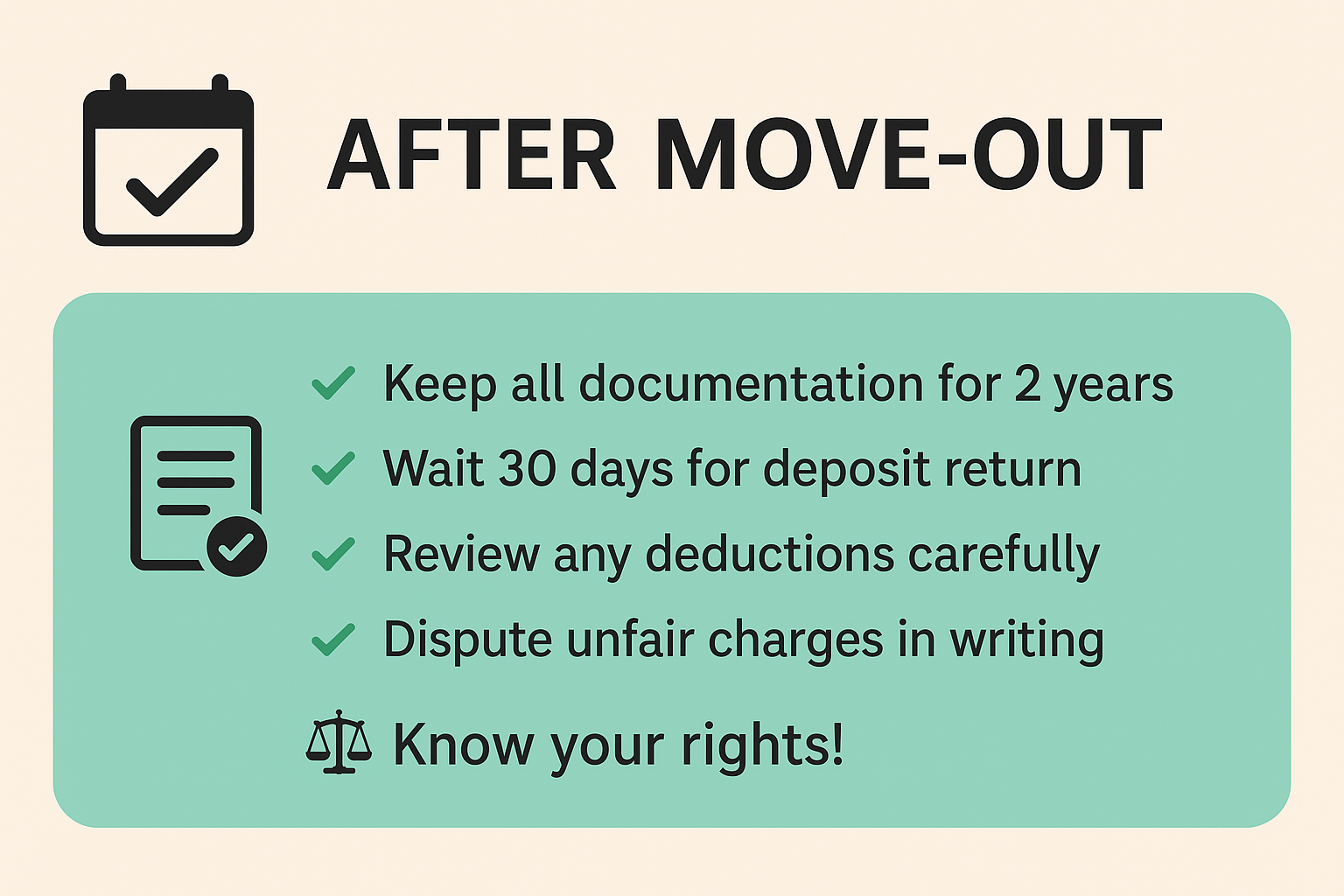
Keep These For: 2 years minimum after move-out
What Happens After You Move Out
Understanding the timeline helps you know when to take action.
Massachusetts Law Timeline:
Within 30 Days: Landlord must either:
- Return full security deposit with interest, OR
- Return remaining balance with itemized deductions
The Itemized List Must Include:
- Detailed description of each deduction
- Actual cost of each repair/cleaning
- Receipts, invoices, or estimates
- If deduction exceeds $100, at least 2 estimates
If They Miss This Deadline: You may be entitled to triple damages plus interest and attorney fees.
If You Disagree With Deductions
Step 1: Review Carefully (Day 1-3)
When you receive the itemized list:
- [ ] Compare to your move-in photos
- [ ] Check against Statement of Condition
- [ ] Verify charges are reasonable
- [ ] Confirm they provided proper documentation
- [ ] Calculate if amounts are fair
Common Unfair Deductions:
- Normal wear and tear (explicitly not allowed)
- Routine painting
- Carpet cleaning for normal wear
- Cleaning that’s not beyond what you left
- Pre-existing damage
- Professional cleaning fees (as of 2025)
Step 2: Send Written Response (Within 10 Days)
If deductions are unfair, respond in writing:
[Your Name]
[Forwarding Address]
[Date]

[Landlord Name]
[Landlord Address]

RE: Security Deposit Dispute - [Your Old Address]

Dear [Landlord Name],

I received your itemized deduction list dated [date] regarding my security deposit for [address]. I am writing to dispute the following deductions:

1. [Item]: $[amount] - [Why it's unfair - e.g., "This damage was noted in the Statement of Condition at move-in. See attached photos."]

2. [Item]: $[amount] - [Why it's unfair - e.g., "This constitutes normal wear and tear under Massachusetts law and cannot be deducted per G.L. c. 186, § 15B(4)."]

I have attached:
- Photos from move-in showing [issue]
- Photos from move-out showing [condition]
- Copy of Statement of Condition

Per Massachusetts law, I am requesting return of the improperly withheld amount of $[total] within 10 business days. If we cannot resolve this, I will be forced to pursue the matter in small claims court, where I may be entitled to triple damages, interest, court costs, and attorney fees under G.L. c. 186, § 15B.

I hope we can resolve this amicably. Please contact me at [phone] or [email] to discuss.

Sincerely,
[Your Signature]
[Your Name]
Send Via: Certified mail, return receipt requested
Keep Copies: Of everything you send
Step 3: Consider Small Claims Court (If No Resolution)
If landlord doesn’t respond or you can’t reach agreement:
Massachusetts Small Claims Court:
- For disputes up to $7,000
- No lawyer required (but you can bring one)
- Filing fee: ~$40-150 depending on claim amount
- Usually resolved in 3-6 months
What You Can Win:
- Triple damages (3x the amount wrongfully withheld)
- 5% interest from the date deposit should have been returned
- Court costs
- Reasonable attorney fees (if you hired one)
Example:
- Landlord wrongfully kept: $500
- You can potentially win: $1,500 (triple) + interest + court costs
Free Legal Help:
- Greater Boston Legal Services
- Massachusetts Legal Help
- Housing Court Self-Help Centers
How to File:
- Go to your local Housing Court
- File a small claims complaint
- Serve landlord with complaint
- Attend hearing with all documentation
- Present your case (bring photos, receipts, everything)
Pro Tips for Court:
- Organize documents clearly
- Print photos (don’t rely on showing phone)
- Bring multiple copies for judge
- Be professional and calm
- Stick to facts, not emotions
- Let evidence speak for itself
Common Landlord Tactics (And How to Counter)
Tactic 1: “You didn’t clean well enough” Counter: Show photos of cleaned apartment + professional cleaning receipt if applicable
Tactic 2: “This damage wasn’t here before” Counter: Show Statement of Condition and move-in photos
Tactic 3: “Cleaning costs more than you think” Counter: Get 2-3 competing quotes showing actual market rates
Tactic 4: “You signed away your rights in the lease” Counter: Massachusetts law supersedes lease terms; illegal clauses are void
Tactic 5: Ignoring your letters Counter: Certified mail creates paper trail; proceed to court if needed
Section 8: Frequently Asked Questions
After 500+ Boston move-outs, here are the questions we hear most often:
About Cleaning Requirements
Q: Do I legally have to hire professional cleaners in Massachusetts?
A: No. As of August 2025, Massachusetts law prohibits landlords from requiring professional cleaning or automatically deducting cleaning fees from security deposits. You must leave the apartment clean, but you can do it yourself.
Q: What does “broom-clean” actually mean?
A: Legally, it means swept floors, empty apartment, and trash removed. Practically, most Boston landlords expect more: vacuumed/mopped floors, wiped surfaces, and clean bathrooms and kitchen. See our Level 2 standard in Section 2 for what most landlords expect.
Q: Can my landlord require me to steam clean carpets?
A: No, unless you caused damage beyond normal wear and tear (like stains). Normal carpet wear from walking is not your responsibility to professionally clean.
About Security Deposits
Q: How long does my landlord have to return my security deposit?
A: 30 days from your move-out date. They must either return the full deposit with interest, or return the remainder with an itemized list of deductions including receipts.
Q: What can my landlord legally deduct from my security deposit?
A: Only three things:
- Unpaid rent (that wasn’t lawfully withheld)
- Unpaid water bills (if you were responsible)
- Cost to repair actual damage you caused (beyond normal wear and tear)
They CANNOT deduct for normal wear and tear, routine painting, or routine cleaning.
Q: What counts as “normal wear and tear” in Massachusetts?
A: Faded paint, minor scuffs on walls, worn carpet from foot traffic, small nail holes from pictures, furniture indentations in carpet, minor scratches on hardwood from normal use. Basically, damage that occurs from ordinary living with reasonable care.
Q: Can my landlord keep my deposit for a dirty oven?
A: If the oven has grease buildup that goes beyond normal use (not just everyday cooking residue), yes. This is one of the most common legitimate deductions we see. Clean your oven thoroughly!
About Timing
Q: When should I clean my Boston apartment before moving out?
A: 2-3 days before your move-out date. This gives you time to do it right, fix any issues, and not rush. Don’t wait until the last day!
Q: I’m moving on September 1st. When should I clean?
A: Clean by August 28-29 at the latest. September 1st is Boston’s busiest moving day—streets are chaos, you’ll be exhausted, and professional cleaners are fully booked. Many landlords are flexible about the exact date due to the citywide chaos, but not about cleanliness standards.
Q: How far in advance should I book professional cleaning?
A:
- Regular season: 2-3 weeks
- May (graduation): Early April
- September 1st: Early-mid August
- Last minute might work in winter, but expect rush fees
About Boston-Specific Issues
Q: Do I have to clean salt damage from Boston winters?
A: Yes. Salt tracked in during winter needs to be cleaned from floors, baseboards, and carpets. Use a vinegar solution for hardwood and vacuum carpets multiple times. This is considered your responsibility, not normal wear.
Q: What about radiator cleaning? That seems like landlord’s job.
A: You’re responsible for dust on radiators. Vacuum the fins and wipe down surfaces. It’s part of regular cleaning. However, you’re NOT responsible for repairs or painting radiators.
Q: My apartment has old everything. Do I need to make it look new?
A: No. You return it in the same condition as you found it (documented in your Statement of Condition), minus normal wear and tear. If the oven was already dirty at move-in and you have photos proving it, you don’t need to deep clean it.
About Professional Cleaning
Q: How much does move-out cleaning cost in Boston?
A:
- Studio/1BR: $250-400
- 2BR: $350-550
- 3BR: $450-700
- Prices vary by neighborhood, condition, and season
Get a free quote for your apartment →
Q: Is professional cleaning worth it?
A: Usually yes if:
- Your deposit is $2,000+
- You have 2+ bedrooms
- You’re moving far away
- You have limited time
- You want guaranteed results
- You’re in a luxury building
For small apartments with low deposits, DIY might make sense if you have time.
Q: What’s included in professional move-out cleaning?
A: Typically:
- Kitchen deep clean (inside appliances)
- Bathroom sanitization
- All floors vacuumed and/or mopped
- All surfaces wiped
- Baseboards cleaned
- Windows cleaned (interior)
- Light fixtures dusted
Ask for specific list when booking.
About Documentation
Q: Should I take photos after cleaning?
A: YES! This is crucial. Take photos of every room from multiple angles after cleaning. Date-stamp them. These photos are your evidence if the landlord disputes the condition.
Q: Do I need to attend the final walkthrough?
A: It’s highly recommended. This gives you a chance to address any concerns immediately, creates mutual agreement on condition, and gets everything in writing. If your landlord won’t do one, document that you requested it.
Q: What if I already moved to another state?
A: This makes professional cleaning even more important since you can’t easily return. Get extensive photos and consider having a friend attend the walkthrough as your representative (with written authorization).
About Specific Situations
Q: I’m a student in Allston/Brighton. Different rules?
A: Same laws apply, but expectations might be slightly lower in student housing since landlords expect higher turnover. However, you still need to clean thoroughly—especially the kitchen. Don’t assume “student housing” means you can skip cleaning.
Q: I lived there less than a year. Do I still get interest on my deposit?
A: No. Interest only applies if the tenancy lasted one year or longer.
Q: Can I use my security deposit to pay last month’s rent?
A: Generally no, unless your landlord specifically agrees in writing. The security deposit and last month’s rent are legally separate.
Q: What if my roommates trashed the apartment?
A: If you’re all on the lease, you’re all jointly and severally liable. The landlord can deduct from any/all security deposits. Consider taking your roommates to small claims court to recover your share if they caused the damage.
About Problem Situations
Q: There’s damage I didn’t cause. What do I do?
A: If damage existed when you moved in:
- Check your Statement of Condition
- Look at your move-in photos
- Show landlord proof it was pre-existing
- Reference it in your move-out communication
Q: My landlord wants to charge me for things that seem unfair. Help?
A:
- Review what’s legal to deduct (see Section 1)
- Compare to your documentation
- Send written dispute (see Section 7)
- Contact Mass Legal Help if needed
- Consider small claims court (you can win triple damages)
Q: My landlord hasn’t returned my deposit after 30 days. What now?
A:
- Send certified letter demanding return
- Give them 10 days to respond
- File in small claims court if no response
- You may win triple damages plus interest and costs
Conclusion: Your Boston Move-Out Success Plan
Moving out of your Boston apartment doesn’t have to be stressful, and you absolutely can get your full security deposit back. Let’s recap your action plan:
Your Move-Out Timeline
3-4 Weeks Before:
- [ ] Re-read your lease cleaning requirements
- [ ] Find your Statement of Condition from move-in
- [ ] Review your move-in photos
- [ ] Decide: DIY or professional cleaning?
- [ ] If professional: Get quotes and book now
- [ ] If DIY: Gather supplies and schedule cleaning days
2 Weeks Before:
- [ ] Request final walkthrough with landlord
- [ ] Start decluttering and packing
- [ ] Note any problem areas needing extra attention
3-5 Days Before:
- [ ] If DIY: Begin major cleaning
- [ ] Start with oven (needs soaking time!)
- [ ] Work through checklist room by room
- [ ] Address Boston-specific issues (salt, radiators, etc.)
1-2 Days Before:
- [ ] Finish any remaining cleaning
- [ ] Do final walkthrough with checklist
- [ ] Take extensive “after” photos and videos
- [ ] Address any missed spots
- [ ] Remove all belongings completely
Move-Out Day:
- [ ] Quick sweep/wipe if needed
- [ ] Final look in every closet, cabinet, drawer
- [ ] Attend walkthrough with landlord
- [ ] Get condition documented in writing
- [ ] Return all keys (get receipt)
- [ ] Provide forwarding address
After Move-Out:
- [ ] Keep all documentation for 2 years
- [ ] Wait for deposit return (30 days)
- [ ] Review any deductions carefully
- [ ] Dispute unfair charges in writing
- [ ] Seek legal help if needed
The Three Keys to Getting Your Full Deposit Back
1. Know Your Rights
- Massachusetts law protects you from unfair deductions
- 2025 ruling prohibits mandatory professional cleaning
- Normal wear and tear is not your responsibility
- You have strong legal remedies if landlord violates law
2. Document Everything
- Photos at move-in and move-out
- Keep Statement of Condition
- Save all receipts and correspondence
- Create paper trail for everything
3. Clean Thoroughly (Or Hire Pros)
- Don’t skip the oven!
- Address Boston-specific issues (salt, radiators)
- Use our detailed checklist
- Consider professional cleaning for peace of mind
Choose Your Path
Ready to DIY?
???? Download Our Free Resources:
- Printable Room-by-Room Checklist
- Supply Shopping List
- Photo Documentation Template
- Timeline Planning Worksheet
Want Professional Help?
We’ve completed over 500 Boston move-out cleanings with a 99% success rate for full deposit returns.
✅ Satisfaction guaranteed
✅ 2-4 hour completion
✅ All supplies included
✅ Fully insured & bonded
✅ Boston neighborhood experts
✅ Before/after photos provided
Get Your Free Quote: Brabos Cleaning Move-Out Services
We genuinely want Boston renters to get their deposits back. We’ve seen too many good tenants lose money over minor issues that could have been easily prevented.
Final Thoughts
Your security deposit represents significant money—often $2,000-4,000 in Boston. With the right knowledge and approach, that money should come back to you in full.
Remember:
- You have legal rights (especially with the 2025 ruling)
- Documentation is your best friend
- Thorough cleaning pays for itself
- Professional help is often worth the investment
- Small claims court is available if you need it
Whether you’re a BU student moving out of your first Allston apartment, a young professional leaving a South End condo, or a family transitioning from a Cambridge home, this guide has given you everything you need for a successful Boston move-out.
Don’t lose your hard-earned deposit money over cleaning issues that are completely preventable.
Moving Into Your Next Boston Apartment?
Book move-in cleaning to start fresh: Move-In Cleaning Services
About the Author
Adriano is the founder of Brabos Cleaning, Boston’s trusted move-in/move-out cleaning service since [year]. With over 500 successful Boston move-out cleans across every neighborhood—from historic Beacon Hill brownstones to modern Seaport high-rises—Brabos understands exactly what it takes to pass a Boston landlord’s inspection and get your full security deposit back.
Brabos Cleaning specializes in:
- Move-in/move-out cleaning
- Deep cleaning services
- Recurring cleaning
- Airbnb turnover cleaning
Serving: Back Bay, South End, South Boston, Allston, Brighton, Cambridge, Somerville, Quincy, Brookline, Newton, and all Greater Boston neighborhoods.
Good luck with your move, and remember: A clean departure leads to a fresh start!
Last Updated: October 2025 | Have suggestions for this guide? Email us at info@braboscleaning.com
Moving in Somerville or Cambridge? See our local pages: move-out cleaning in Somerville, MA → and move-in/move-out cleaning in Cambridge → — landlord-walkthrough checklist, insured W-2 teams.